
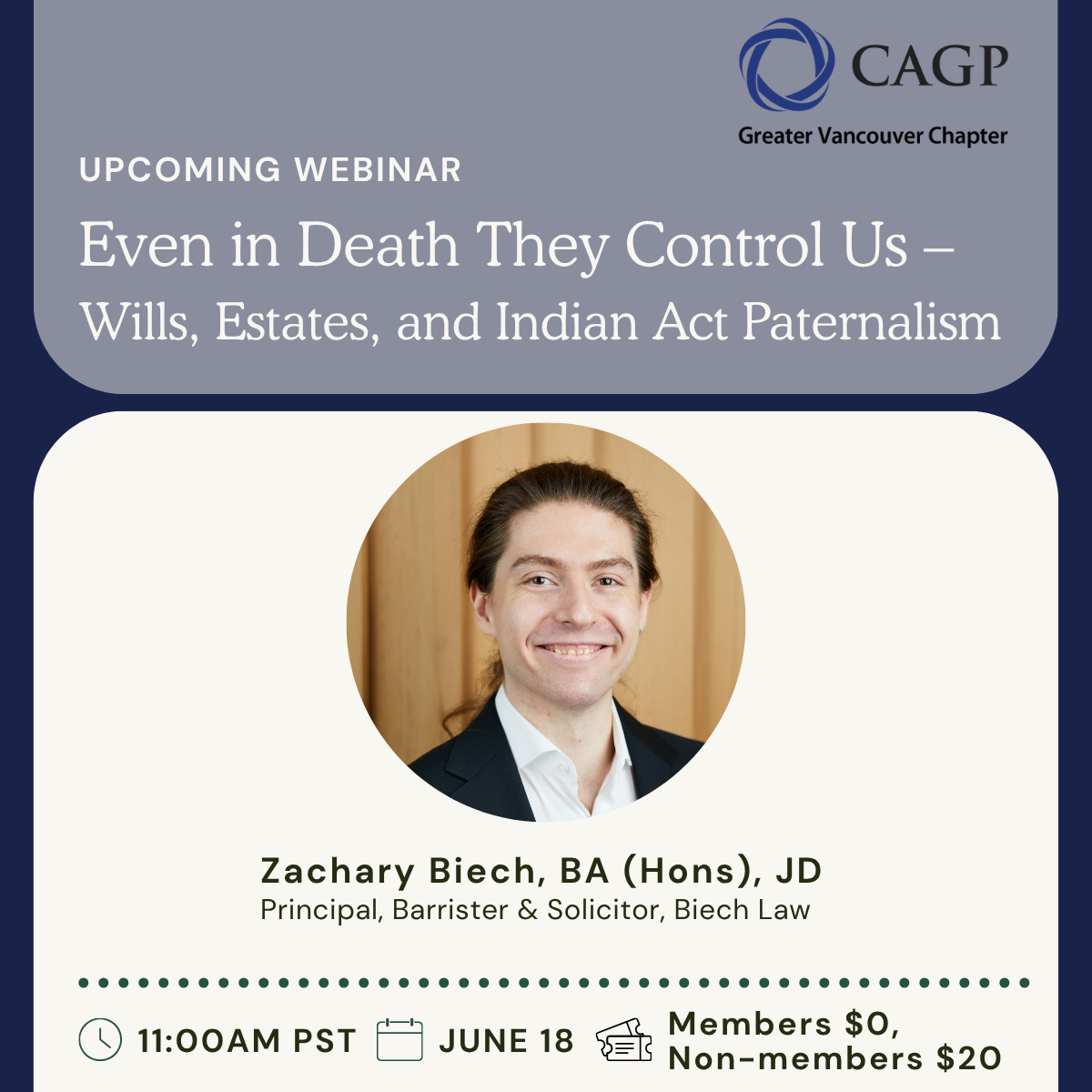
For First Nations people in Canada, every aspect of life (and death) is regulated under the Indian Act. The Minister of Indigenous Services has the final say in every major life decision for status Indians, from getting a house on reserve to writing wills and administering estates. In practice, this institutionalized paternalism creates many complex questions for status Indians and professional gift planners to consider.
This presentation will seek to highlight some of these questions, first by exploring the Indian Act’s broader assimilatory history, and then by exploring the specific legal provisions which impact will and estates. In so doing, this presentation will highlight relevant connections to other important instruments, such as the Final Report of the Truth and Reconciliation Commission of Canada, and the United Nations Declaration on the Rights of Indigenous Peoples
Zachary Biech, BA (Hons), JD, Principal, Barrister & Solicitor at Biech Law, is a member of Ahtahkakoop Cree Nation, and is a proud nēhiyaw. He has been practicing law for the past five years, and is a member of the Alberta and Ontario bars. Having worked in both the Aboriginal and environmental law fields, and in both private and charitable sectors, he has worked with a wide range of Indigenous communities, organizations, individuals, and allied NGOs, all of whom bring extraordinary dedication, knowledge, and creativity to the work of de-colonization. The experience he gained from this work has shaped his practice deeply, and has inspired him to step out into sole practice as both a lawyer and strategic consultant for Indigenous peoples and their allies.
Canada
| Member | $ 0.00 + $ 0.00 Tax |
| Non-Member | $ 20.00 + $ 0.00 Tax |