BEGIN:VCALENDAR
VERSION:2.0
PRODID:-//CiviCRM//NONSGML CiviEvent iCal//EN
X-WR-TIMEZONE:America/New_York
METHOD:PUBLISH
BEGIN:VTIMEZONE
TZID:America/New_York
BEGIN:DAYLIGHT
TZOFFSETFROM:-0400
TZOFFSETTO:-0400
TZNAME:EDT
DTSTART:20261007T073000
END:DAYLIGHT
END:VTIMEZONE
BEGIN:VEVENT
UID:CiviCRM_EventID_1706_8956e17444ee51ed2535655e1f22898a@www.cagp-acpdp.org/en
SUMMARY:Planning for Your Legacy: Estate Planning & Strate
gic Philanthropy
X-ALT-DESC;FMTTYPE=text/html:Sometim
es charitable planning conversations start in the
wrong place. A tax strategy emerges\, and the fami
ly's goals are then reverse-engineered around it.
This session reverses that process. Using a practi
cal five-step framework\, Mariska guides participa
nts through the process of clarifying the legacy\,
building the estate plan\, planning the tax strat
egy\, selecting the appropriate giving vehicle\, a
nd coordinating implementation. Along the way\, pa
rticipants will see how family objectives\, legal
structures\, tax considerations\, and philanthropi
c goals operate as an interconnected system\, wher
e decisions in one area inevitably affect the othe
rs.
\n
\n The session explores the plan
ning concepts that matter most\, including how don
ation tax credits function across income levels\,
why gifts of appreciated securities often outperfo
rm cash donations\, when charitable gifts should b
e aligned with liquidity events\, and how to evalu
ate corporate versus personal giving strategies. T
hree detailed case studies will bring these concep
ts to life. Each case contrasts a client's existin
g charitable strategy with a more effective altern
ative\, quantifying the retirement\, tax\, and est
ate consequences so participants can clearly see t
he impact of thoughtful planning decisions.
\
n Learning Objectives
\n
\n By the end
of this session\, participants will be able to:
\n
\n -Lead charitable planning discussio
ns that begin with donor intention rather than tax
outcomes by identifying who should benefit\, what
values or causes should be supported\, when gifts
should occur\, and the level of control a donor w
ishes to retain before recommending a charitable s
tructure.
\n -Evaluate and quantify the tax c
onsequences of competing charitable strategies\, i
ncluding gifts of appreciated securities versus ca
sh\, lifetime giving versus charitable bequests\,
corporate versus personal donations\, and donation
s coordinated with significant liquidity events.\n -Match charitable giving vehicles to a dono
r's circumstances and develop an implementation pl
an by assessing planned gifts in light of the dono
r's tax capacity\, liquidity needs\, philanthropic
objectives\, and desired level of control\, while
coordinating the advisors required to execute the
strategy.
\n \n 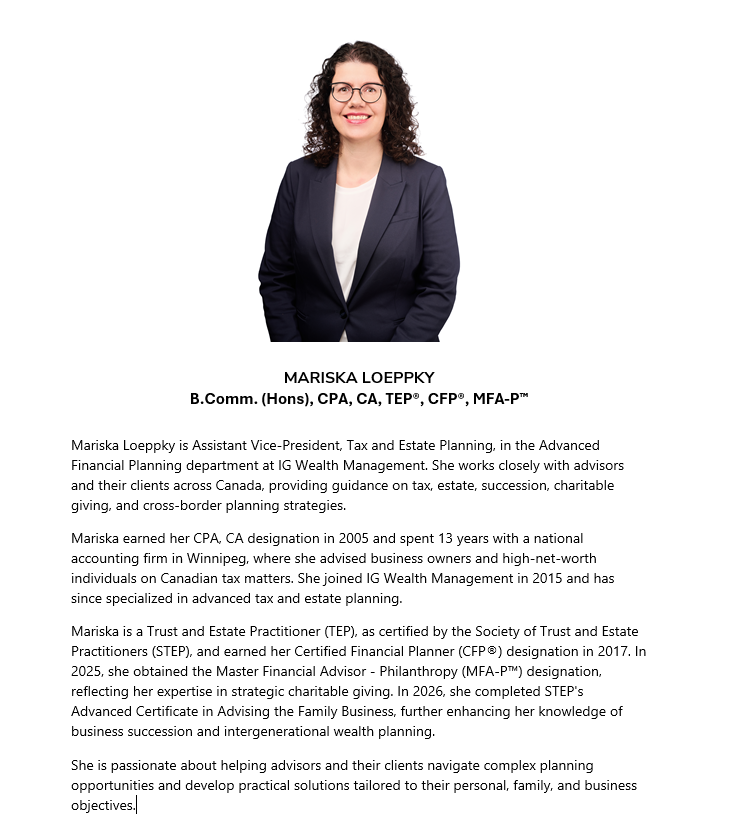
DESCRIPTION:Sometimes charitable planning conversations start
in the wrong place. A tax strategy emerges\, and t
he family's goals are then reverse-engineered arou
nd it. This session reverses that process. Using a
practical five-step framework\, Mariska guides pa
rticipants through the process of clarifying the l
egacy\, building the estate plan\, planning the ta
x strategy\, selecting the appropriate giving vehi
cle\, and coordinating implementation. Along the w
ay\, participants will see how family objectives\,
legal structures\, tax considerations\, and phila
nthropic goals operate as an interconnected system
\, where decisions in one area inevitably affect t
he others.\n \n \n \n The session explores the pla
nning concepts that matter most\, including how do
nation tax credits function across income levels\,
why gifts of appreciated securities often outperf
orm cash donations\, when charitable gifts should
be aligned with liquidity events\, and how to eval
uate corporate versus personal giving strategies.
Three detailed case studies will bring these conce
pts to life. Each case contrasts a client's existi
ng charitable strategy with a more effective alter
native\, quantifying the retirement\, tax\, and es
tate consequences so participants can clearly see
the impact of thoughtful planning decisions.\n \n
Learning Objectives\n \n \n \n By the end of this
session\, participants will be able to:\n \n \n \n
-Lead charitable planning discussions that begin
with donor intention rather than tax outcomes by i
dentifying who should benefit\, what values or cau
ses should be supported\, when gifts should occur\
, and the level of control a donor wishes to retai
n before recommending a charitable structure.\n \n
-Evaluate and quantify the tax consequences of co
mpeting charitable strategies\, including gifts of
appreciated securities versus cash\, lifetime giv
ing versus charitable bequests\, corporate versus
personal donations\, and donations coordinated wit
h significant liquidity events.\n \n -Match charit
able giving vehicles to a donor's circumstances an
d develop an implementation plan by assessing plan
ned gifts in light of the donor's tax capacity\, l
iquidity needs\, philanthropic objectives\, and de
sired level of control\, while coordinating the ad
visors required to execute the strategy.\n \n \n \
n \n \n
CATEGORIES:Chapter Event
CALSCALE:GREGORIAN
DTSTAMP;TZID=America/New_York:20261007T073000
DTSTART;TZID=America/New_York:20261007T073000
DTEND;TZID=America/New_York:20261007T093000
LOCATION:Winnipeg Winter Club\n 200 River Ave\n Winnipeg\,
MB R3L 0B2\n Canada\n
URL:https://www.cagp-acpdp.org/en/civicrm/event/info?reset=1&id=1706
END:VEVENT
END:VCALENDAR